TMJ and jaw problems: what upper cervical research has looked at

Your jaw clicks or aches, your bite feels off, and maybe your ears ache too. The dentist made a guard. It helps at night, and the rest of the day it's still there.

How we approach TMJ and jaw pain →

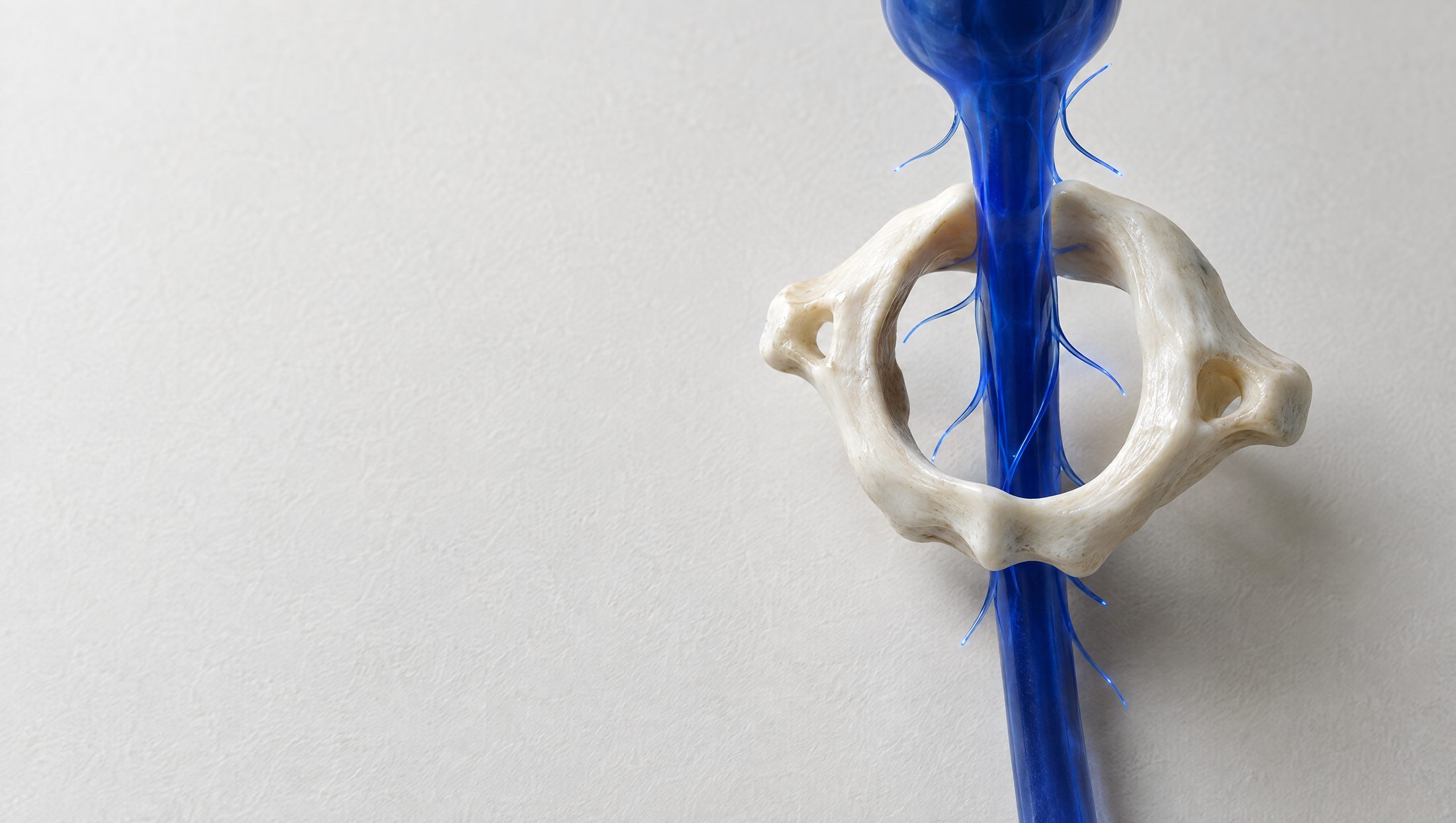
Illustration: the atlas, the top vertebra of the neck, with a blue nerve passing through it

The jaw joint sits just in front of the ear and only a few centimeters from the top of the neck. Whether the position of the head on the neck affects the bite is a fair question, and a NUCCA research group has measured it. This page gathers that study and two case reports, one of them about QSM3, the method used at our office.

3 studies on this page

  • Designs: Before-and-after study, case report
  • Published: 2002 to 2020
  • NUCCA lineage: marked on the NUCCA studies. QSM3, the method used at our office, is a progression of NUCCA.

Where these studies sit, by design and year

3 studies, published 2002 to 2020. Strongest design: cohort, pilot or before-and-after study. 1 in the NUCCA lineage, ringed.

the studies

What each study looked at

Strongest study design first. The dots show the design, from a single case (one dot) to a controlled trial (four). How to read this library

Before-and-after study2016NUCCANUCCA lineage

Bite balance and posture, measured before and after a NUCCA correction

Who and how many
Adults under active NUCCA care in private practice. The abstract does not give the number of people.
What was measured
Posture, and the balance of the bite on a dental force plate (T-Scan). Each person was measured twice before and after the correction, so they served as their own comparison.
What was found
Changes in posture and in the pattern of bite contact could be seen after the NUCCA correction. Not everyone's bite became more balanced.
Limits
Small, from private practice, and with no separate control group. The authors call for more study, and for chiropractors and dentists to work together on jaw problems.

Read the abstract on PubMed → Source 1

Case report2020QSM3 (Quantum Spinal Mechanics)QSM3, our methodNot indexed in PubMed

A 36-year-old woman with chronic jaw pain, and QSM3 care

Who and how many
One woman, 36, with several years of TMJ pain that began after an injury, made worse by moving her jaw, sleeping and straining.
What was measured
Her posture and her jaw pain, through QSM3 care and several months of follow-up care.
What was found
The authors report that her posture improved and her jaw pain resolved after the first QSM3 correction, with no return of pain over several months of continued care.
Limits
One person and no comparison. The paper's key words also list myofascial release, and the abstract doesn't say whether other care was part of her plan.

Read the abstract on the journal's site → Source 2

Case report2002Gonstead, at the atlas

A 41-year-old woman with jaw problems, ear pain, ringing and vertigo

Who and how many
One woman, 41, with ear pain on both sides, tinnitus, vertigo, reduced hearing and headaches, diagnosed with temporomandibular joint (TMJ) syndrome. Care from a medical doctor and a dentist had not helped.
What was measured
Her symptoms over the course of care directed at the atlas.
What was found
Her symptoms improved and then resolved after 9 visits.
Limits
One person, and the result is her own report. The technique was Gonstead, a full-spine method that uses a quick, high-velocity correction, applied here to the atlas. That is a different style of care from the orthogonal approach used at our office.

Read the abstract on PubMed → Source 3

before you draw conclusions

What this research does and doesn't tell you

The NUCCA study shows that posture and bite readings can change after a correction, and that not everyone's did. It does not report whether jaw symptoms changed. The case reports each describe one woman: one with QSM3, one with a different technique. Jaw problems often need a dentist as well, and the authors of the NUCCA study say the two professions should work together.

Published research can't predict what will happen for any one person, including you. Studies report averages and single stories; your nervous system is your own. That is why The Lazar Method™ starts with measurement, not with a promise.

We measure first, so the answer is about you, not an average.

Before any correction we measure how your nervous system is regulating your body: heart rate variability, thermal and muscle tone scans, PostureIQ™, and digital X-ray of the upper neck. QSM3, the method used at our office, is a progression of NUCCA. Dr. Jonathan Lazar, D.C., or someone personally trained by him, will go over your scans and images with you.

If we can help, we'll tell you. If we can't, we'll help you find someone who can.

Talk it through on a 15-minute Clarity Call →

This page is educational and is not medical advice. Keep the doctors who know you in the loop.
citations

Sources

  1. Westersund CD, Scholten J, Turner RJ. 2016. Relationship between craniocervical orientation and center of force of occlusion in adults. Cranio 35(5):283-289. PubMed 27760504 · DOI 10.1080/08869634.2016.1235254
  2. Paxton SW, Oppelt M. 2020. Resolution of Chronic Temporomandibular Disorder in a 36-Year-Old Female Following Chiropractic Care: A Case Study Journal of Upper Cervical Chiropractic Research October 27, 2020:63-67. Not indexed in PubMed. Article page on vertebralsubluxationresearch.com
  3. Alcantara J, Plaugher G, Klemp DD, Salem C. 2002. Chiropractic care of a patient with temporomandibular disorder and atlas subluxation. J Manipulative Physiol Ther 25(1):63-70. PubMed 11898020 · DOI 10.1067/mmt.2002.120415

Titles are quoted exactly as published. Sources checked 2026-11-03.

tried everything

When nothing else has worked, start with clarity.

In about 4 minutes, you'll see whether your symptoms point to nervous system dysfunction, and exactly what to do next. Free. Your answers stay private. No spam, ever.

Prefer to talk first?

or call 734.274.5107 · ready to come in? Book your complimentary consultation

Screening adapted from the autonomic dysfunction screening developed by Bruce Bell, MD.

A member of our team will reach out within one business day.