
your plan of care
Get better. Stay well. Feel alive.
Don't confuse feeling better with getting better. This is the road a plan of care at Lazar Upper Cervical Chiropractic follows, and why the middle of it matters most.
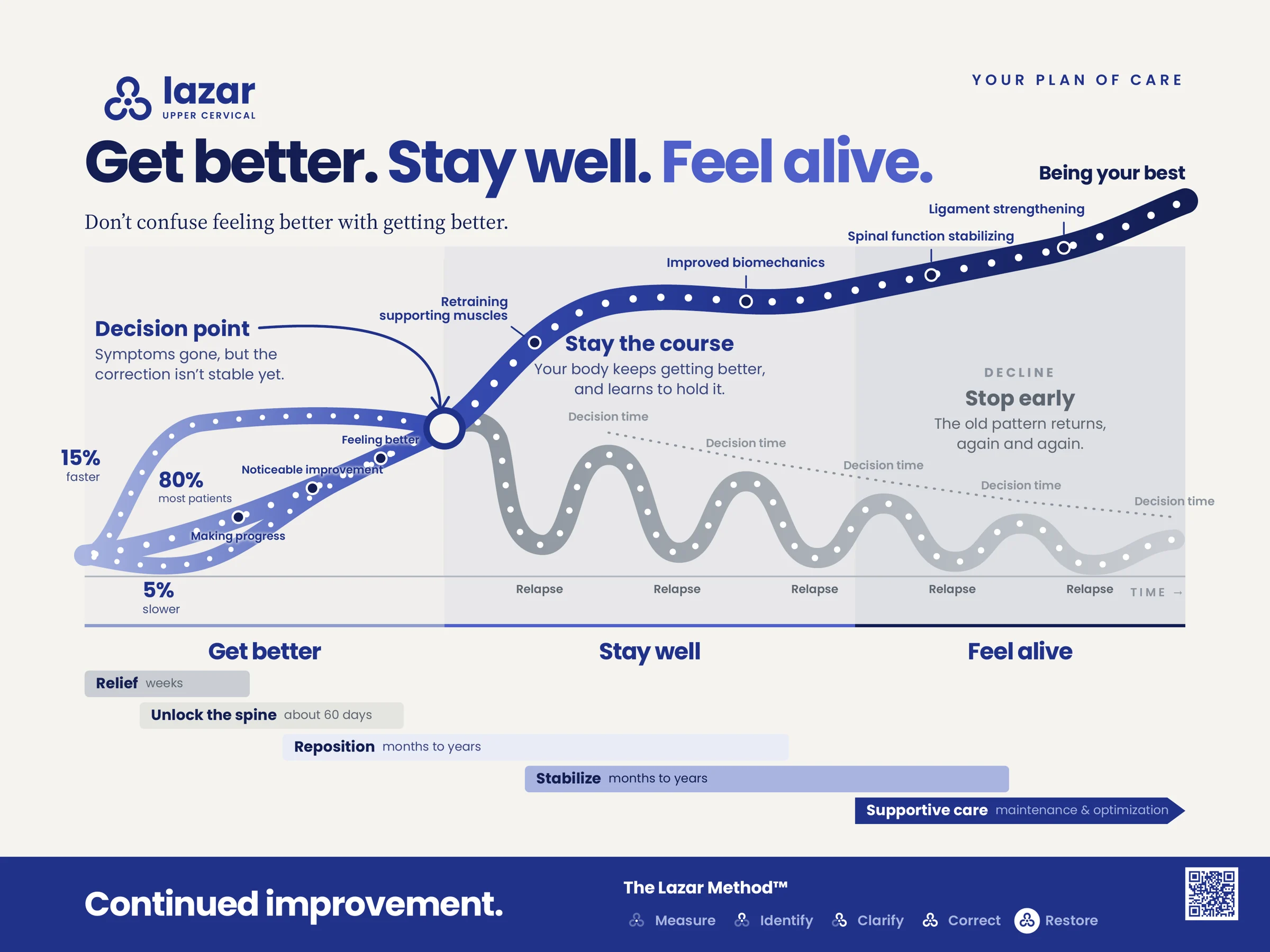
the decision point
Symptoms can ease before the correction is stable.
Most people reach a point where they feel noticeably better, sometimes within weeks. The spine and the muscles that hold it have not finished learning the new position yet. What happens next is a decision.
Stay the course
The body keeps adapting and learns to hold the correction: supporting muscles retrain, biomechanics improve, spinal function stabilizes, ligaments strengthen. Re-scans show it on paper.
Stop early
The old pattern tends to return, and the decision comes around again, and again. Each time, the starting point is the same place you left.
the phases
What each stretch of the road is for.
- Relief
weeks. The first phase. Visits are most frequent here, because this is when the correction is most likely to hold. Many people notice they feel different early on.
- Release the spine
about 60 days. Joints that have been locked in a stressed position begin to move again. Feeling better often arrives here, well before the correction is stable.
- Reposition
months to years. The framework of the body is guided back toward its normal. QSM3 uses the upper neck as the lever, so posture and balance are re-measured along with the neck.
- Stabilize
months to years. Ligaments and the supporting muscles are retrained to hold the new position. Visits taper as your scans stabilize.
- Supportive care
maintenance and optimization. Scheduled re-scans and visits keep the correction where it belongs and show, on paper, how it is holding.
Your own timeline is set at your Report of Findings, from your own scans, and it is in writing before you decide anything. If Dr. Lazar finds you need a plan of care, he will tell you. If we can help, we'll tell you. If we can't, we'll help you find someone who can.
the lazar method™
The same five steps, every time.
tried everything
When nothing else has worked, start with clarity.
In about 4 minutes, you'll see whether your symptoms point to nervous system dysfunction, and exactly what to do next. Free. Your answers stay private. No spam, ever.
Prefer to talk first?
or call 734.274.5107 · ready to come in? Book your complimentary consultation
Screening adapted from the autonomic dysfunction screening developed by Bruce Bell, MD.
A member of our team will reach out within one business day.